
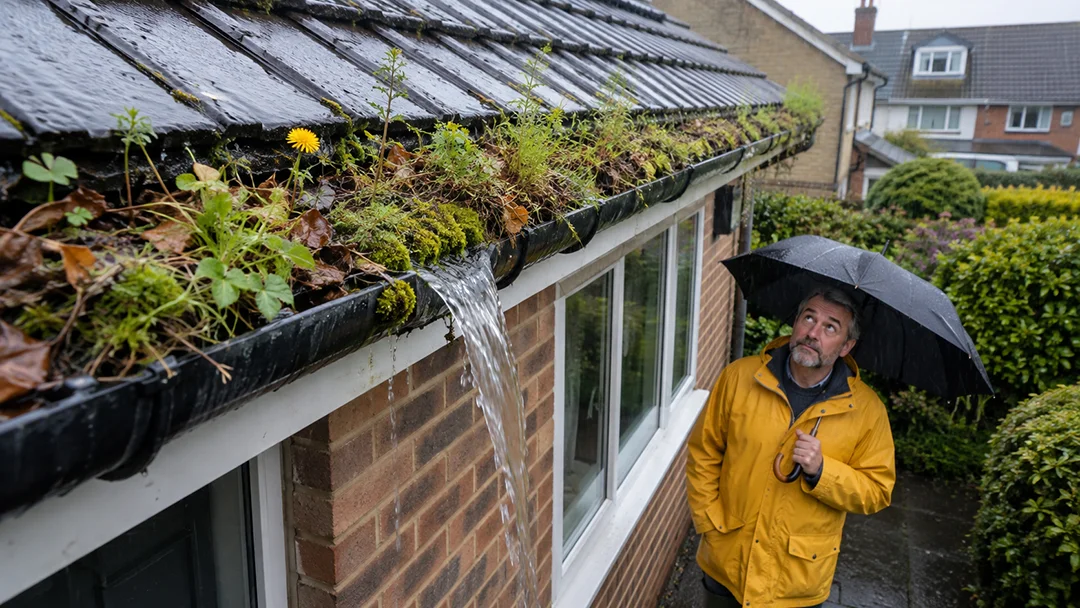
A few leaves in a gutter rarely look like an urgent roofing problem. Even water spilling over the edge during heavy rain can be easy to dismiss as something to deal with another day.
The difficulty is that blocked gutters do not simply make a mess on the ground. They repeatedly direct rainwater towards some of the most vulnerable parts of a property: the roof edge, fascia boards, soffits, wall coverings and the timber behind them.
The damage often develops slowly and out of sight. By the time a homeowner notices damp indoors, peeling paint or a gutter pulling away from the roofline, the original blockage may already have caused a much wider problem.
In a wet climate such as West Yorkshire’s, gutters need to move a considerable amount of water away from the roof. Keeping that route clear is one of the simplest ways to protect the roof and the fabric of the building beneath it.
Your gutters are part of the roof’s drainage system
A pitched roof is designed to shed rainwater quickly. Tiles or slates direct it towards the eaves, where the gutter collects it and carries it to an outlet. The downpipe then takes the water safely towards the drainage system.
That sequence only works when every section remains clear and correctly aligned.
Leaves, moss, twigs, roof grit and nesting material can collect in the gutter channel. The debris may form a visible mass, but it can also create a dense blockage directly over the outlet where it is harder to see. Water then builds up faster than it can escape.
During light rain, a partially blocked system may appear to cope. The problem often reveals itself during sustained or heavy rainfall, when the reduced capacity causes water to spill over the front or back of the gutter.
The same principle applies to flat roofs. Their rainwater outlets and drainage channels must remain clear. When an outlet is obstructed, water can pond on the roof covering and place greater pressure on joints, edges and vulnerable areas of the waterproofing system.
What happens when rainwater has nowhere to go?
When a gutter fills with water, it will eventually overflow. Where that water travels depends on the position of the blockage, the gutter alignment and the condition of the roofline.
Water spilling over the front may run down brickwork, render, windows and doors. Overflow at the back is less obvious and can be more damaging because it sends water towards the fascia, soffit and underside of the roof edge.
Roofing underlay is intended to help manage small amounts of moisture beneath the tiles, but it should not be subjected to repeated saturation from a full gutter. Older underlay may already be brittle, torn or poorly supported at the eaves. Persistent wetting can expose weaknesses that had previously caused no visible problem.
Once moisture reaches the roofline timbers, drying can be slow. Shaded eaves receive limited sunlight and ventilation, particularly during autumn and winter. Timber that remains damp becomes vulnerable to decay, while painted or capped surfaces may hide the deterioration developing behind them.
The roof edge is often where the damage begins
The fascia board is not merely a decorative strip. It closes and protects the roof edge and commonly provides the fixing point for gutter brackets. If water repeatedly soaks the fascia, timber boards can soften, split or rot.
As the fascia weakens, brackets may loosen and the gutter can begin to sag. This changes the fall of the gutter, creating low points where more water and debris collect. A small blockage can therefore create a cycle of standing water, poor drainage and increasing strain on the roofline.
Soffits can also become stained, swollen or damaged. Moisture entering the eaves may affect the ends of rafters, roof battens or other concealed timber. These repairs are more involved than simply clearing out a gutter because the damaged roofline may need to be opened and the affected material replaced.
Water running down an external wall can produce algae, dark staining and localised deterioration in masonry joints or render. It may also contribute to penetrating damp, particularly where the wall already has cracks, failed seals or porous areas.
Standing water places extra strain on the guttering
Gutters are made to carry flowing rainwater, not hold a permanent load of wet leaves, moss and silt.
A blocked section can become surprisingly heavy, especially after days of rain. Plastic gutters may distort or pull apart at joints. Metal systems can corrode where water and organic material remain trapped. Brackets may twist or separate from weakened fascia boards.
Once the gutter has moved, clearing the debris may not restore correct drainage. The system might still hold water because its fall has been lost, a joint has opened or an outlet has become misaligned. This is why an overflowing gutter should be checked as a complete system rather than treated as nothing more than a handful of leaves.
Downpipes can cause similar problems. A pipe may appear clear at the top but contain compacted material lower down, particularly at bends or where it meets the drain. Water then backs up into the gutter and overflows close to the outlet.
Cold weather can turn a blockage into a larger defect
Winter adds another layer of risk. Standing water can freeze inside gutters, outlets and downpipes. As it expands, it can place pressure on joints, seals and fittings that may already be weakened.
Frozen debris is also heavier and cannot move through the system when rain or melting frost arrives. Water may be forced over the gutter edge or back towards the eaves.
Repeated wetting and freezing can accelerate deterioration around cracks in masonry, damaged render and ageing roofline components. A gutter that only appeared to overflow occasionally in autumn may therefore become a persistent problem through the colder months.
Warning signs that should not be ignored
You do not need to wait for water to enter the property. Blocked or failing gutters usually provide earlier clues, particularly during or immediately after rainfall.
| Warning sign | What it may indicate |
|---|---|
| Water spilling over the gutter edge | Debris, a blocked outlet, an obstructed downpipe or insufficient fall. |
| Plants, moss or visible leaf build-up | Organic material has remained long enough to retain moisture and support growth. |
| A gutter that sags or holds water after rain | Loose brackets, weakened fascia, distortion or an incorrect fall. |
| Dark marks below the roofline | Regular overflow is wetting the wall, fascia or soffit. |
| Peeling paint or swollen timber | Moisture may have penetrated the protective surface of the roofline. |
| Damp near the top of an external wall | Water may be entering around the eaves, although the source should be properly investigated. |
A damp mark should not automatically be blamed on a slipped tile. Water can travel along roof timbers, underlay or wall surfaces before it becomes visible, so the internal stain may be some distance from the original gutter defect.
How often should gutters be checked?
There is no maintenance interval that suits every home. A property surrounded by mature trees or affected by heavy moss growth will need attention more often than a house in a more open position.
For many properties, checking the gutters after the main autumn leaf fall and again in spring is a sensible starting point. Additional inspections may be needed after high winds, prolonged rain or roofing work that could have left fragments in the system.
Gutter guards can reduce the amount of larger debris entering the channel, but they do not make the system maintenance-free. Fine material, moss and silt can still collect around or beneath them, while leaves may cover the guard and prevent water entering the gutter correctly.
Cleaning should include the outlets and downpipes, not only the visible horizontal sections. The gutter should also be checked for standing water, damaged seals, open joints, loose brackets and areas that have lost their fall.
Working from ladders or at roof height can be dangerous. If the gutters are difficult to reach, the ground is uneven or there is any doubt about safe access, the inspection and cleaning should be left to someone with the correct equipment and experience.
Clearing the blockage may only be the first step
If a blockage is caught early, clearing the debris and flushing the outlet may be all that is required. Where overflowing has continued for some time, it is important to check whether it has already affected the surrounding roofline.
A proper inspection may need to consider:
- The alignment and fall of the guttering.
- The condition and spacing of brackets.
- Joints, seals, stop ends and outlets.
- Downpipe bends and connections to the drain.
- Fascia and soffit boards behind the gutter.
- The eaves, underlay and lower courses of tiles or slates.
- Signs of damp or decay in accessible roof timbers.
Repairing a leaking joint while leaving a sagging run or blocked downpipe in place will not solve the underlying drainage problem. The aim should be to restore a clear, correctly supported route that carries water away from the building.
Protect your roofline before a small problem spreads
Blocked gutters are easy to overlook because the early signs appear outside and may only be visible when it rains. However, every overflow sends water somewhere it was not designed to go.
Regular maintenance is far less disruptive than replacing rotten fascias, repairing damaged eaves or tracing a persistent damp problem. If your gutters overflow, sag, leak at the joints or leave staining below the roofline, dealing with the cause early can prevent the repair from becoming more extensive.
JDH Roofing provides professional fascia, soffit and guttering services alongside comprehensive roof repairs throughout West Yorkshire. Our experienced team can inspect the full roofline, identify where the water is escaping and explain whether cleaning, realignment, repair or replacement is the most appropriate solution.
To arrange an inspection or discuss a guttering or roofline problem, call 01924 497540 or 07522 052151, email info@jdhroofing.co.uk,